P – Point
AI did not just help me work better — it helped me work much faster.
While planning Ecomobi’s Company Trip, New Year Party, and 10-Year Anniversary, I used AI as a thinking partner, not just a writing tool. The result was a significant reduction in planning time, while still maintaining cultural depth, emotional coherence, and a strong DEIB lens.
For complex People & Culture projects, speed and quality do not have to be trade-offs when AI is used intentionally.
R – Reason
Planning a 10-year anniversary is not a typical event-planning task.
It requires:
- Strong alignment with Ecomobi culture and core values
- Clear connection between multiple big events, not standalone activities
- An inclusive DEIB perspective for a multi-country, multi-role workforce
- Several review rounds with leadership, especially the CPO
In a traditional approach, much of the time is spent on:
- Drafting and re-drafting plans
- Manually stress-testing emotional flow and cultural alignment
- Reworking content due to late-stage feedback
AI helped shorten these cycles by acting as: a fast, context-aware thinking partner that could challenge, validate, and refine ideas early.
E – Evidence: How I Used AI in Practice
1️⃣ Setting the right core context before any planning started
I did not use ChatGPT in a simple question-and-answer way.
Instead, I created a custom GPT in ChatGPT Plus with one clear requirement:
AI must understand Ecomobi — our culture, people, and way of working — before giving any advice.
The core context I provided included:
- Culture: One Ecomobi – One Team – One Goal – One Standard
- Core values: Integrity – Value-Oriented – Growth Hacking
- Markets: Vietnam, Indonesia, Philippines, Singapore
- Workforce: multi-country, multi-generation (Gen Y & Z dominant), multi-role
- Vision, mission, and operating principles
DEIB was embedded as a thinking lens, not as a standalone initiative:
- Respecting differences while reinforcing a shared “One Ecomobi” identity
- Designing experiences where different groups can see themselves represented
- Avoiding storytelling that focuses only on a “core team” or a single market
Prompt – Core context setup
You are a Strategic People & Culture Partner supporting a multi-market company.

Core context:
- Company culture: One Ecomobi – One Team – One Goal – One Standard
- Core values: Integrity, Value-Oriented, Growth Hacking
- Markets: Vietnam, Indonesia, Philippines, Singapore
- Workforce: multi-country, multi-generation (Gen Y & Z dominant), diverse functions
- Leadership philosophy: build people before building results

DEIB lens:
- Diversity across markets, roles, seniority, and perspectives
- Inclusion reflected in decision-making and storytelling
- Belonging means employees can see themselves in the company journey

All outputs must reflect this context and be practical, implementable, and culturally aligned.
2️⃣ Bringing in real business problems: from Company Trip to the 10-Year Anniversary
Once the foundation was clear, I started working with AI on real planning challenges.
I provided detailed inputs on:
- Company Trip (Oct 2025): objectives and its role in the 10-year journey
- Core ideas of the New Year Party and the 10-Year Anniversary
- The desired emotional curve — not just “fun,” but build-up, reflection, and momentum
- Expected outcomes: alignment, connection, and energy for the next phase
Prompt – Defining the problem and context
I am planning a series of internal events including:
- Company Trip (Oct 2025)
- New Year Party
- 10-Year Anniversary

These events are connected as one journey, not standalone activities.

Inputs:
- Strategic objectives of the company at its 10-year milestone
- Emotional curve expectation across the journey
- Multi-market and multi-role audience
- DEIB lens: inclusive experience across countries and functions

Please review the overall direction and identify:
- Strengths
- Gaps
- Risks in emotional flow or inclusivity
3️⃣ Using AI to review, challenge, and refine the plan
Instead of asking AI to “write the full plan,” I used it to challenge my own thinking.
I asked AI to:
- Review the emotional curve and check for bias toward certain groups
- Examine timelines and stages for overload or weak moments
- Test the alignment between activities and expected outcomes
- Suggest more focused and realistic alternatives
Prompt – Review and critique
Based on the plan provided, please:
1. Review the emotional curve across all stages
2. Identify any emotional or engagement gaps
3. Assess alignment between activities and expected outcomes
4. Highlight DEIB risks (who might feel left out or underrepresented)
5. Suggest improvements while keeping feasibility in mind
4️⃣ Adding constraints and finalizing before leadership review
At the final stage, I added more real-world inputs:
- Resource and timing constraints
- Team readiness and execution capacity
- Strategic priorities from leadership
The goal was to let AI stress-test the plan one last time before I finalized it and reviewed it with the CPO.
Prompt – Final check
With the updated inputs and constraints:
- Please re-evaluate the plan
- Confirm alignment with strategic and cultural outcomes
- Flag any remaining risks
- Provide a concise summary suitable for leadership review
5️⃣ Visualizing the journey
After the plan was finalized, I moved to visualization.
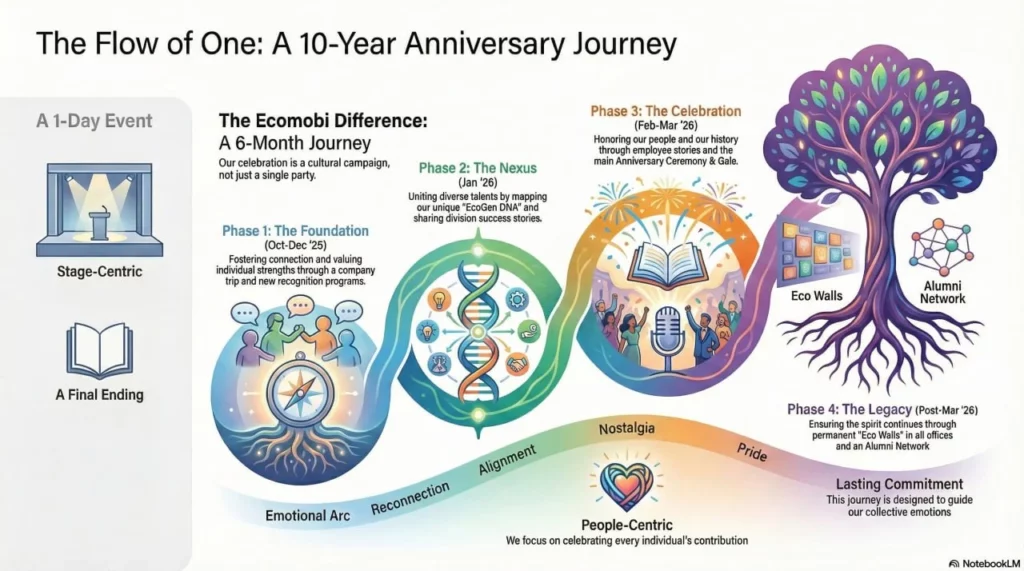
I transferred the full plan into NotebookLM to:
- Convert it into a journey-based slide structure
- Visualize timelines and emotional flow
- Create a short video that tells the 10-year story
Prompt – Visualization
Transform this finalized plan into:
- A slide outline following the employee journey
- Clear stages and emotional peaks
- Key messages per stage

Tone: inspiring, inclusive, and aligned with company culture.
Time Impact: Before vs. With AI
👉 This represents a 65–70% reduction in total planning time.
More importantly, the time saved was not used to “do more tasks,” but to:
- Have deeper conversations with leadership
- Review cultural and DEIB risks more carefully
- Make better, calmer strategic decisions
P – Point
AI does not replace the role, judgment, or accountability of a People Leader.
What it does is help us reach better decisions faster, with fewer unnecessary iterations.
In a complex People & Culture project like Ecomobi’s 10-Year Anniversary, AI acted as:
- A thinking accelerator
- A fast, context-aware reflection loop
- A support system that reduced operational friction without removing human intent
By shortening planning cycles and reducing rework, AI gave me back time and mental space to focus on what truly matters: people, culture, and long-term impact.
For me, the real value of AI is not productivity alone, but clarity under pressure.
That is why I see AI not as a temporary tool, but as a core capability People teams should intentionally build as Ecomobi moves into its next chapter.