Finding new publisher leads on YouTube used to be a manual, time-consuming task:
open one channel → scroll → check content → guess traffic quality → repeat.
So my team needed a way to:
- Discover relevant creators faster
- Focus on performance-driven channels, not just big names
- Spend time talking to publishers, not hunting them
So I built a simple workflow using ChatGPT + Google Colab that now helps me identify YouTube leads at scale—without paid tools.
The Problem with Manual YouTube Lead Hunting
Most people search YouTube like this:
- “finance review Indonesia”
- “loan app review”
- “e-wallet tutorial”
The problem?
- Results are biased toward big creators
- Smaller but high-converting channels are buried
- No easy way to filter by content relevance or intent
I needed structure.
The Solution: ChatGPT for Logic + Google Colab for Execution
Think of this workflow as:
- ChatGPT = strategist
- Google Colab = worker
I don’t use AI to replace judgment—I use it to remove repetitive work.
Step 1: Define Lead Criteria with ChatGPT
Before touching any code, I use ChatGPT to help me define what a “good lead” looks like.
Example prompt:
“Help me define YouTube channel criteria for finance affiliate campaigns in Indonesia. Focus on mobile apps, reviews, and tutorial-style content.”
This helps me clearly define:
- Keywords to target (loan, e-wallet, trading, banking apps)
- Channel types (review, comparison, walkthrough)
- Red flags (re-upload channels, no voice, misleading content)
This step alone prevents bad leads from entering the pipeline.
Step 2: Use Google Colab + YouTube Data API
Next, I move to Google Colab.
Why Colab?
- Free
- Runs Python in the browser
- Easy to connect with APIs
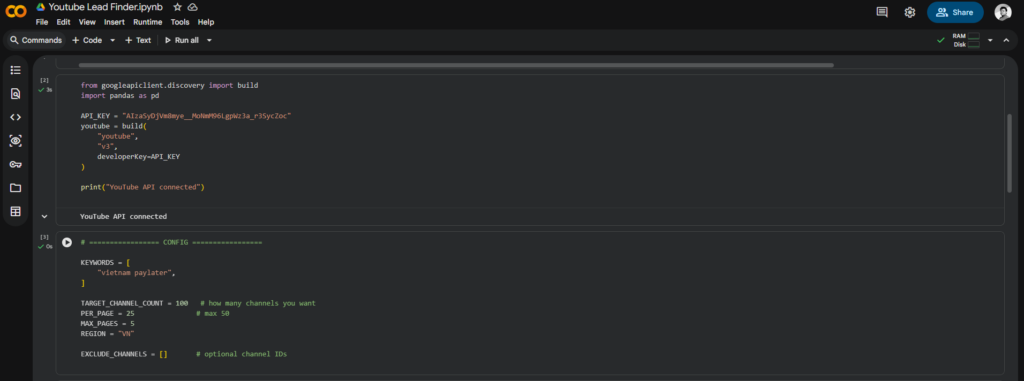
What I extract:
- Channel name
- Channel URL
- Subscriber count
- Video titles & descriptions
This allows me to scan hundreds of channels in minutes instead of hours.
I’m not scraping blindly—I’m searching using strategic keywords from Step 1.
Step 3: Let ChatGPT Classify the Channels
Once I export the channel data (CSV / Sheets), ChatGPT comes back in.
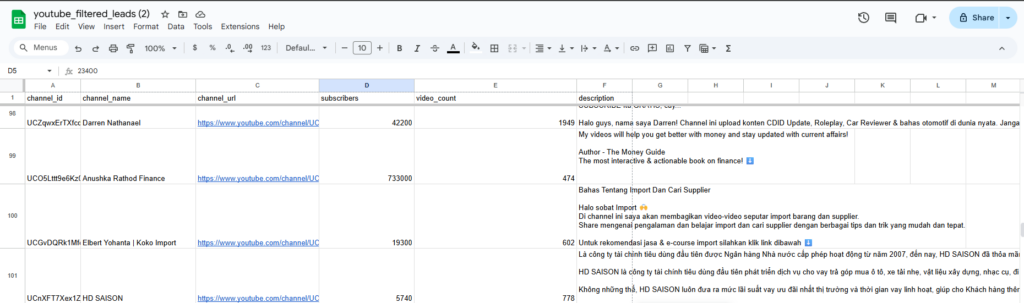
I ask ChatGPT to:
- Classify channels by content intent
- Identify which ones are:
- Review-driven
- Educational
- Promotion-heavy
- Review-driven
- Suggest best outreach angles per channel type
This turns raw data into actionable insights.
Instead of “Here’s a channel,” I now know:
Why this channel makes sense for finance or mobile CPA offers.
Step 4: Prioritize Leads That Can Actually Convert
Not all creators convert.
Using simple signals:
- Consistent uploads
- App-related CTAs
- Comment engagement
- Past brand mentions
I shortlist creators that:
- Already educate users
- Have trust with their audience
- Can switch monetization models easily
These are the publishers advertisers actually want.
Step 5: Faster Outreach, Better Conversations
Because I understand:
- Their content style
- Their audience intent
- Their monetization maturity
My outreach is no longer generic.
Instead of:
“Hi, do you want to work with us?”
I can say:
“I saw your video explaining how X app works. We have a CPA campaign that fits your tutorial-style audience.”
Response rates improve. Conversations start faster.
Why This Matters for Publisher Acquisition
This workflow helps me:
- Reduce lead research time by 70%+
- Find mid-tier creators with high intent
- Scale publisher discovery without extra headcount
- Adapt faster to market shifts (especially in saturated finance & app campaigns)
AI doesn’t replace relationships—but it gets me to the right people faster.
Final Thought
You don’t need expensive tools to work smarter.
If you combine:
- ChatGPT for thinking
- Google Colab for execution
- Your market knowledge for judgment
You can build a lead engine that actually works.
And the best part?
This setup is flexible—you can adapt it to any vertical, any market, any platform.